How to Build a Website Redesign Strategy That Protects What Works
Plan a website redesign around evidence, business goals, user journeys, content, SEO migration, testing, launch, and post-launch measurement.
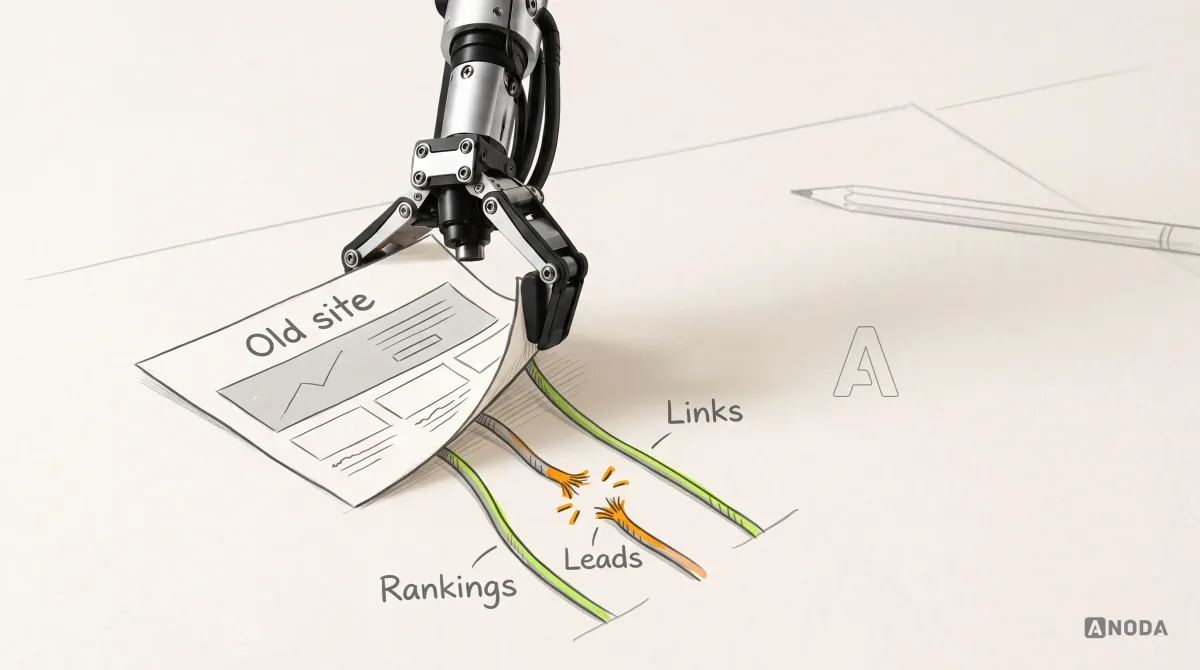
Rework the website you already have — its structure, pages and conversion paths — while every URL, form and integration that works today is mapped and carried over.

Your website reworked, without losing what already works.
Plans and builds a new site from a blank page.
Website Redesign
Reworks a live site and keeps what it has earned.
Not included
Each piece builds on the one before it, and all of it stays yours.
Every page, form and integration listed, with what it earns and what it becomes.
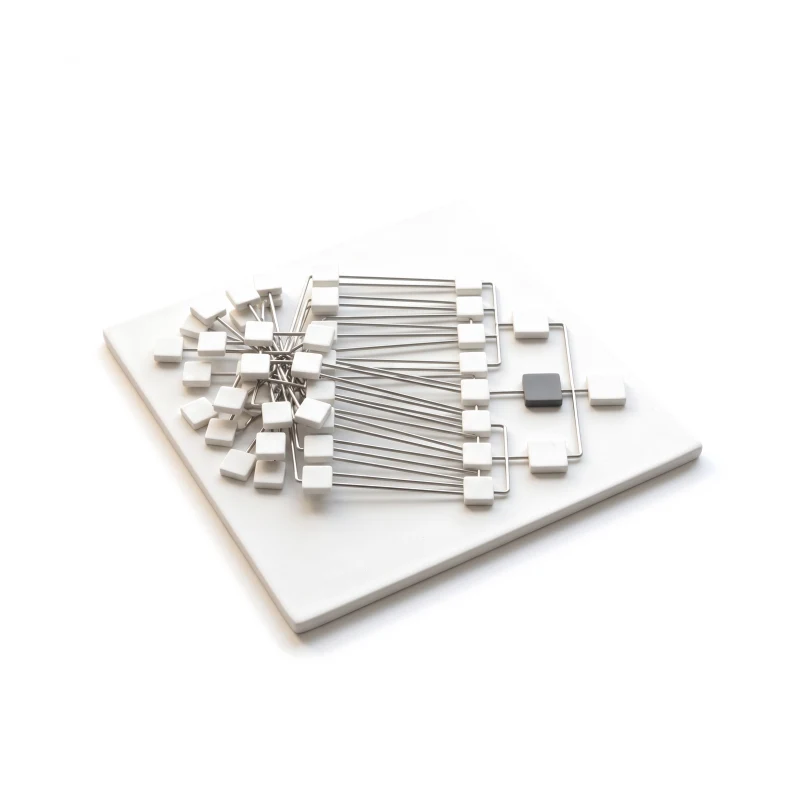
The new site map, with each old URL pointed to its new home.
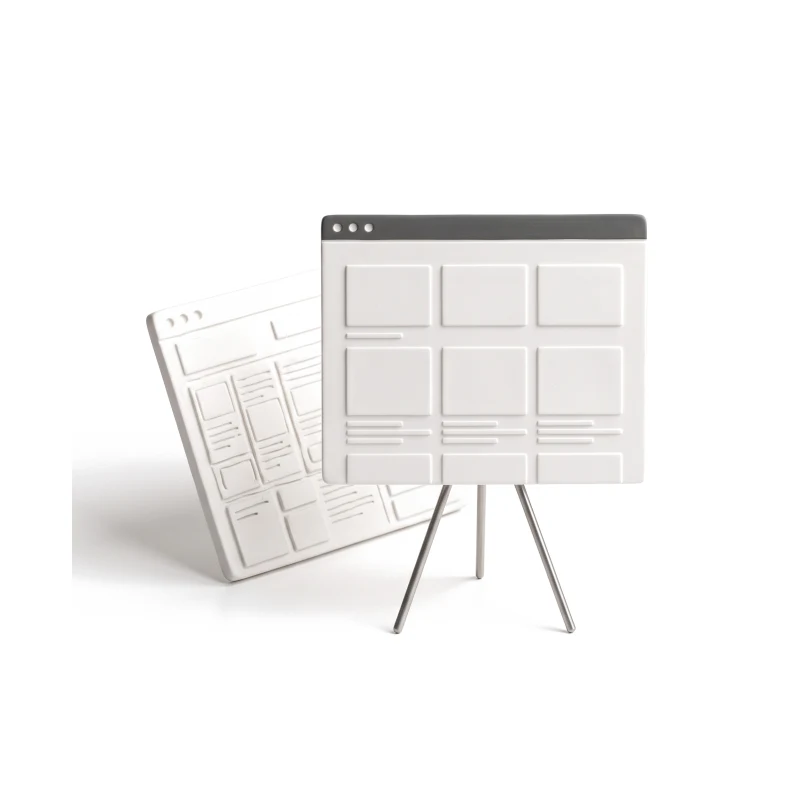
Key templates designed with real content, for phone, tablet and desktop.
Built, content moved, redirects live and checks run before the switch.
You receive
A website redesign agency should tell you, before anything changes, what it rebuilds, what stays with you and your providers, and how the switch is checked. We put that in writing first.
Pages, traffic, forms and integrations reviewed: what brings visits and leads, and what nobody uses. Needs Access to analytics and search console, and a list of the tools the site feeds.
Done when Every page has a verdict — keep, merge, rewrite or retire — that you have approved.
The new site map and conversion paths, with every old URL mapped to its new home. Needs Who the site is for, what they should do next, and who approves the map.
Done when The site map and the redirect map are signed off before design starts.
Key templates with real content first, then the rest of the site from the same blocks. Needs Brand assets, and a decision on whether the brand stays, is refreshed or needs its own project.
Done when The approved designs hold at every breakpoint, at the accessibility level agreed in writing.
Templates and the CMS built, content moved page by page, forms and tools wired back in. Needs The platform decision, a content export, and access or test accounts for each connected tool.
Done when Every kept page exists on the new site, and each form reaches the right inbox or tool.
Redirects set, metadata carried over and checks run; then the switch, and a check for errors after it. Needs Access to the domain and DNS, and one person who decides the launch date.
Done when Old URLs land on the right new pages, nothing returns an error, and the old site stays restorable until you sign off.
ANODA builds
Your team owns
Platforms and tools provide
Key pages designed from scratch in the parent brand's look, then built in Webflow. It shows design and build together, not a URL migration.
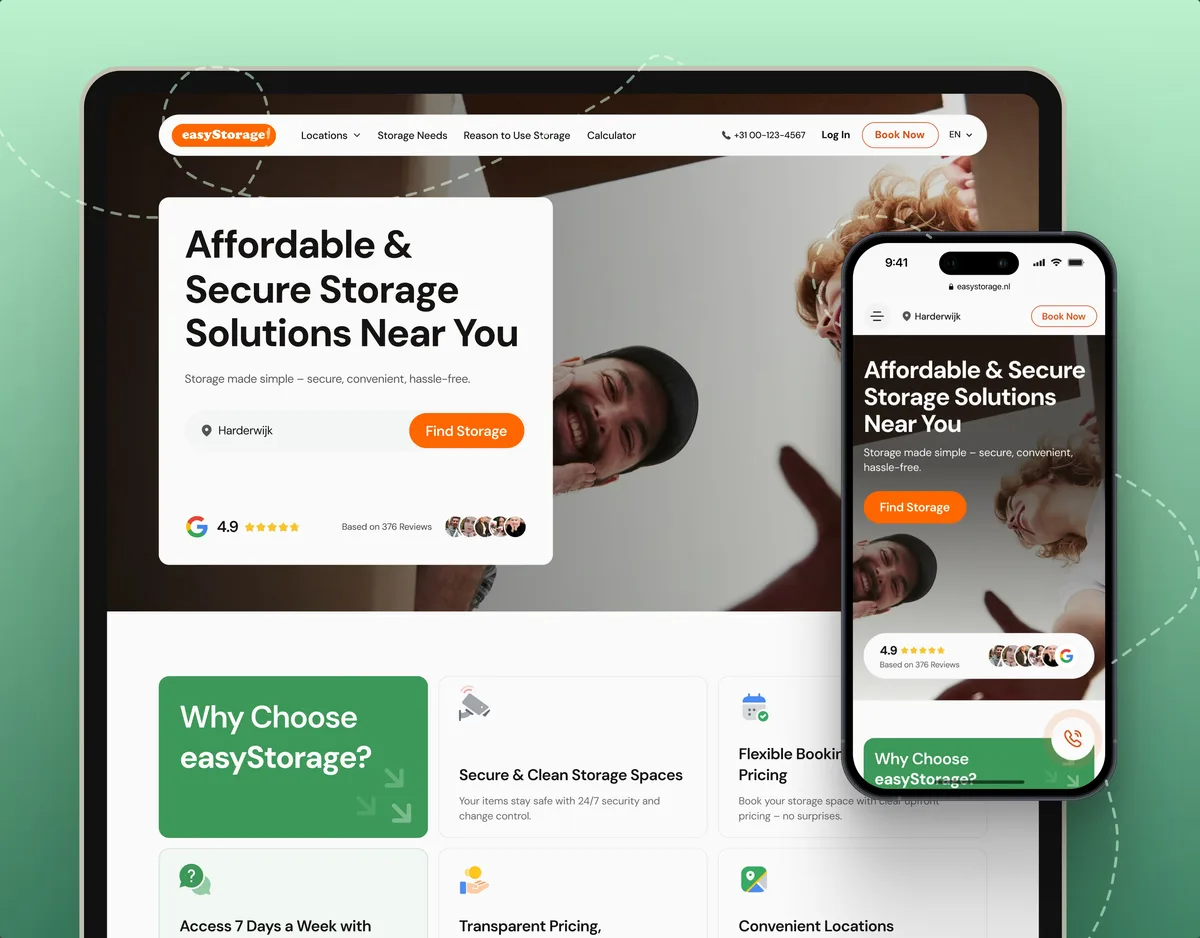
E-commerce · Website
Designed easyStorage NL’s website — information architecture, location and service pages, responsive layouts — built it in Webflow, and redesigned the inherited booking flow.
It fits when the site is worth protecting but no longer does its job. Four signs it is the right step now.
The site describes what you sold two years ago, or a brand you have since replaced.
Pages have piled up, and the route to an enquiry is hard to find.
The templates or the platform make simple edits slow or risky.
Search visits and leads come in, and you cannot afford to lose them in the move.
A different starting point

Tell us what your site runs on and what it no longer does. We will come back with a useful scope and a realistic next step.
The pages in scope, the platform and the review rhythm are agreed before we start.
Tell us its address, what it runs on, and what has to change — the pages, the platform or both.
Message received.
Within 15 minutes, we’ll email you initial feedback and follow-up questions.
Plan a website redesign around evidence, business goals, user journeys, content, SEO migration, testing, launch, and post-launch measurement.
Most AI-generated websites quietly kill conversions. Here's why your AI web design is failing — and the exact prompt to rebuild it for real business results.
Ask to see live sites the team reworked, not only designs, and ask who did the design and who did the build. Then ask how they handle the old site: how they list its pages and URLs, where the redirect map lives, how content is moved and who checks the forms after the switch. A team that talks only about the new look and never about the old URLs is the risk to your traffic.
An audit of the current site — pages, traffic, forms and integrations — and a verdict on each page. Then a new site map with conversion paths, a redirect map from every old URL, page designs for phone, tablet and desktop, the build with its CMS and forms, the content moved across, and a launch with redirects, metadata and checks. A platform move can be part of it, but only when the audit shows it is worth it.
It can, when pages vanish or URLs change without redirects. That is why the audit lists every URL that earns visits or links, and each one gets a new home before design starts. Titles, descriptions and headings that work are carried over, redirects are tested before the switch, and errors and search coverage are checked after it. Search engines re-crawl a new site in their own time, so rankings can move for a while; nobody can guarantee them, and we do not.
Redesign when the site has something worth keeping — traffic, content, links, a platform your team knows — and no longer does its job. If there is no site yet, or nothing worth keeping, start with Website Design. If you do not know why the site underperforms, a UX Audit comes first. If the design is settled and only needs building, Webflow Development is enough. If it is a product people sign in to, you need Product Redesign.
No. Many redesigns stay on the current platform, because it works for the editors and moving carries cost and risk. A move earns its place when simple edits need a developer, the platform blocks what the site must do, or the plan and hosting cost more than they are worth. We compare the options during the audit, and a move is scoped only when you decide on it.
Access to the current site and its CMS, analytics and search console, so we can see which pages earn visits. A list of the forms and tools the site feeds, your brand assets, and one person who approves the site map, the design and the launch. If you have a list of pages the business cannot lose — a pricing page, a top article — tell us early.
The live site on your own accounts, the design file, the CMS set up with its collections and page blocks, the URL and redirect map, and a walkthrough for your editors. After launch we can test key paths with real visitors, add pages, align the site with your product's design system or take on a next phase, each scoped separately.
The number of pages and templates, how much content is kept, rewritten or retired, how many URLs need redirects, the forms and tools the site connects to, and whether the platform changes. We set a custom scope and estimate in the proposal, fixed or phased, and agree the timeline once scope, access and dependencies are clear. A phased plan often suits a large site: the key templates and top pages first, the long tail after.
Products people sign in to, a new brand identity, copywriting at scale, photography, paid media and SEO campaigns. Domain, hosting, platform plans and third-party fees stay in your accounts. We do not promise rankings, traffic, uptime or security beyond the criteria agreed in writing.
The easyStorage NL case shows a website we designed and built in Webflow, with the inherited booking flow redesigned in two rounds, responsive pages and staged releases. It shows design and build together; it is not presented as a URL migration. On your project, the audit and the redirect map are the first things you see and approve.